
Misconceptions:-
1.) Sound: We cannot use sound, as there is vacuum in space. And sound needs a medium of travel. So it is of no use.
2.) Light: We cannot use light also. Firstly space is mostly dark and empty so there is not much to see like you can see while travelling in a car. And secondly because the relative speed at which we and things around us move would be around 400km/seconds. So, we won’t be able to see or analyse things moving that fast with our eyes and brains.
1. External Satellites/GPS
Uses primarily speed of light/electromagnetic radiation to calculate distance and angle between origin and final destination of the vehicle using a satlellite as shown in picture. Here the “Actual Distance travelled” by the space ship from point A to point B will be a trigonometric function {Ysine(θ+β-90)-Xsine(β-90)} derived from X,Y and θ and β.
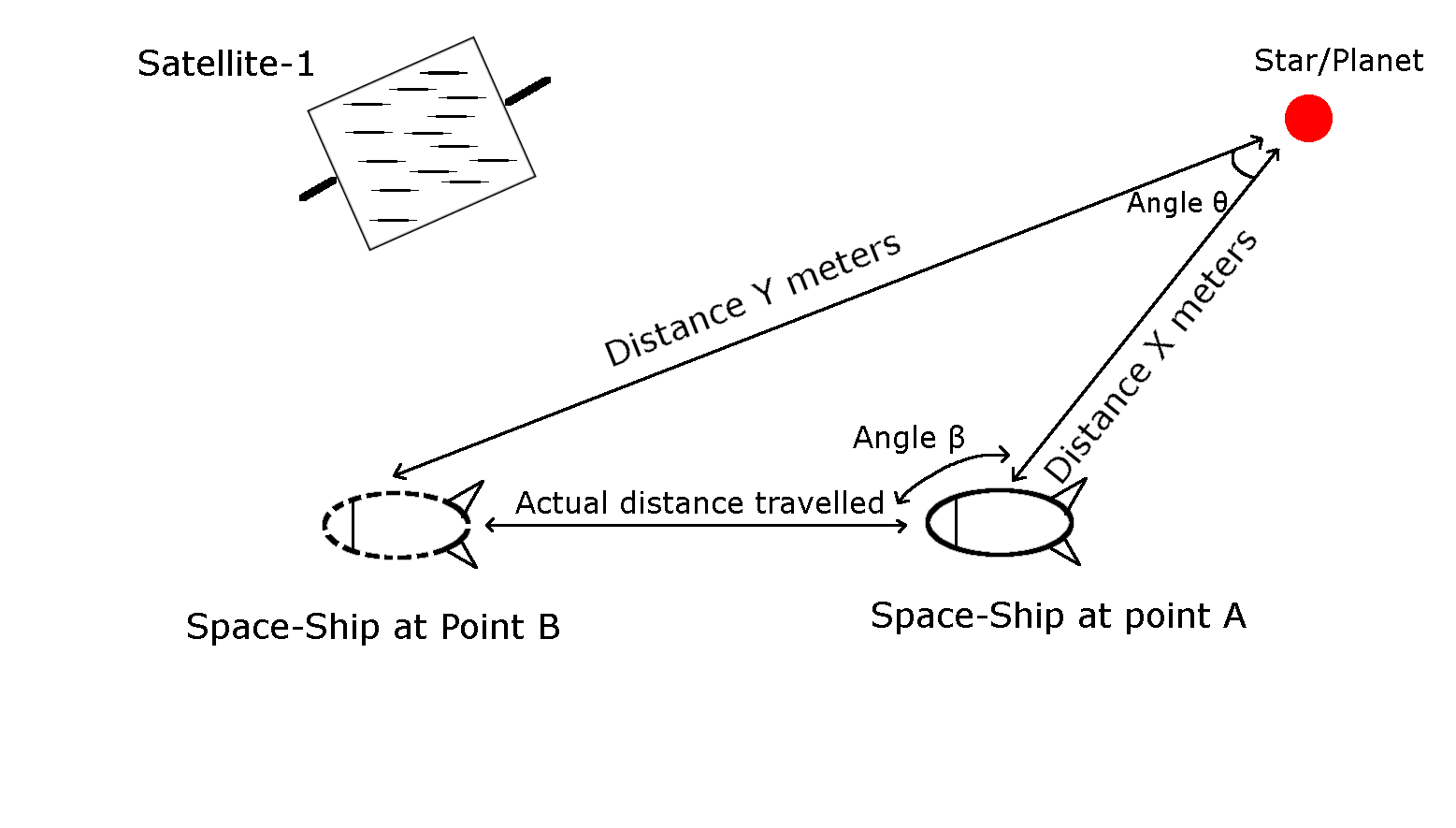
This method is actually outdated and not very useful in deep space. It can be used on small distances on earth only.
2. Space-Time Calibration
Refer this picture.

Lets say that the ratio of time passage on the big red circle which can be planet or star is 1:1. This ratio means that as an absolute reference on Point-1a for every 1 second passed, 1 second only is passed on Point-1a as the location is same. However on a distant Asteroid, time passes such that for every 1 second on the star/planet, 2 seconds pass on the Point-1g, so the calibration/ratio here is 1:2.
Looking at the diagram again on the yellow dots, we can see that there must be a region in space between the asteroid and star/planet where the time passage ratio is 1:1.5 and it is Point-1f. So machines navigate the deep-space and create a table like shown below for all the possible space-time ratios in advance in the region they want the space-ship to travel.
| Absolute Reference star/planet(A-Time) | Relative space-location (R-Time) | Ratio (R-Time/A-Time) | Location in Universe |
| 1 | 1 | 1 | Point-1a |
| 1 | 1.453001 | 1.453001 | Point-1b |
| 1 | 1.453002 | 1.453002 | Point-1c |
| 1 | 1.453003 | 1.453003 | Point-1d |
| 1 | 1.453004 | 1.453004 | Point-1e |
| 1 | 1.5 | 1.5 | Point-1f |
| 1 | 2 | 2 | Point-1g |
Now the space-ship does not need any external source if it knows this table. The space-ship has its own clock/watch inside it, by which it measures the space-time ratio on all directions around it. Lets say its current location is Point-1b(space-time ratio 1.453001), then it will find in which direction the space-time ratio is Point-1c(1.453002). And it will fire the thrusters to move in that direction automatically. When it reaches Point-1c, then it will use the same logic mentioned in the last statement and move to Point-1d, Point-1e and so on. This is the most accurate method of travelling in deep-space.
The only disadvantage here is that, we need to know the space-time calibration in advance before going in that region of space. But it is also safe to know in advance what is lying ahead.
Space-navigation can also be compared to a snake-ladder game

| Snake-bite | Any space rock or obstacle due to which your speed is decreased and you fall down and move towards the nearest planet or star |
| Ladder | Any change in gravitational wave of the space or push from a rock or obstacle, which helps you move away from nearest planet or star |
All the boxes from 1 to 100 are space-time coordinates and can be considered similar to the values starting from 1.453001 to 1.453101, you can skip the first 1.453 for simplicity in comparison to the game
The space-ship is programmed to move from 1 to 100 ideally. But that never happens in reality like in the snake-ladder game, you will almost always encounter a snake or ladder. Similarly in space-navigation also, either your speed will naturally increase or decrease based on any obstacles you may find in your path.
Now if we zoom in and increase the calibration of time in pico or femto seconds and distance in nanometer or lower. And after taking data from different types of matter including solid, liquid and gases. It was found that space-time changes not only in the vaccum of space but even inside matter at atomic level. So we can also conclude that:
The space-time is uniquely different at every single point at atomic scale in this universe
So there is another way to define the states of matter as follows:-
Solid: That state of matter in which the space-time ratio remains consistent for several seconds, minutes, hours, days or years.
Liquid: That state of matter in which the space-time ratio changes in a fraction of seconds
Gas: That state of matter in which the space-time ratio changes within nanoseconds or less.
And this knowledge has led us in making the most advanced technology system in this universe. It has many other applications as well, like:
– In Medical Electronic equipments
– In Artificial Cloning
– In Asteroid Mining for water and food
– In Manufacturing Industry
So we will discuss few more things related to space-time calibration below.
What is an electric short ?
I wanted to discuss this as well becuase it is related to space-time calibration. Let’s say we are passing a current through the circuit below. Current of I1=2.5 A is flowing in Circuit 1 and I2=1.25 A in Circuit 2.
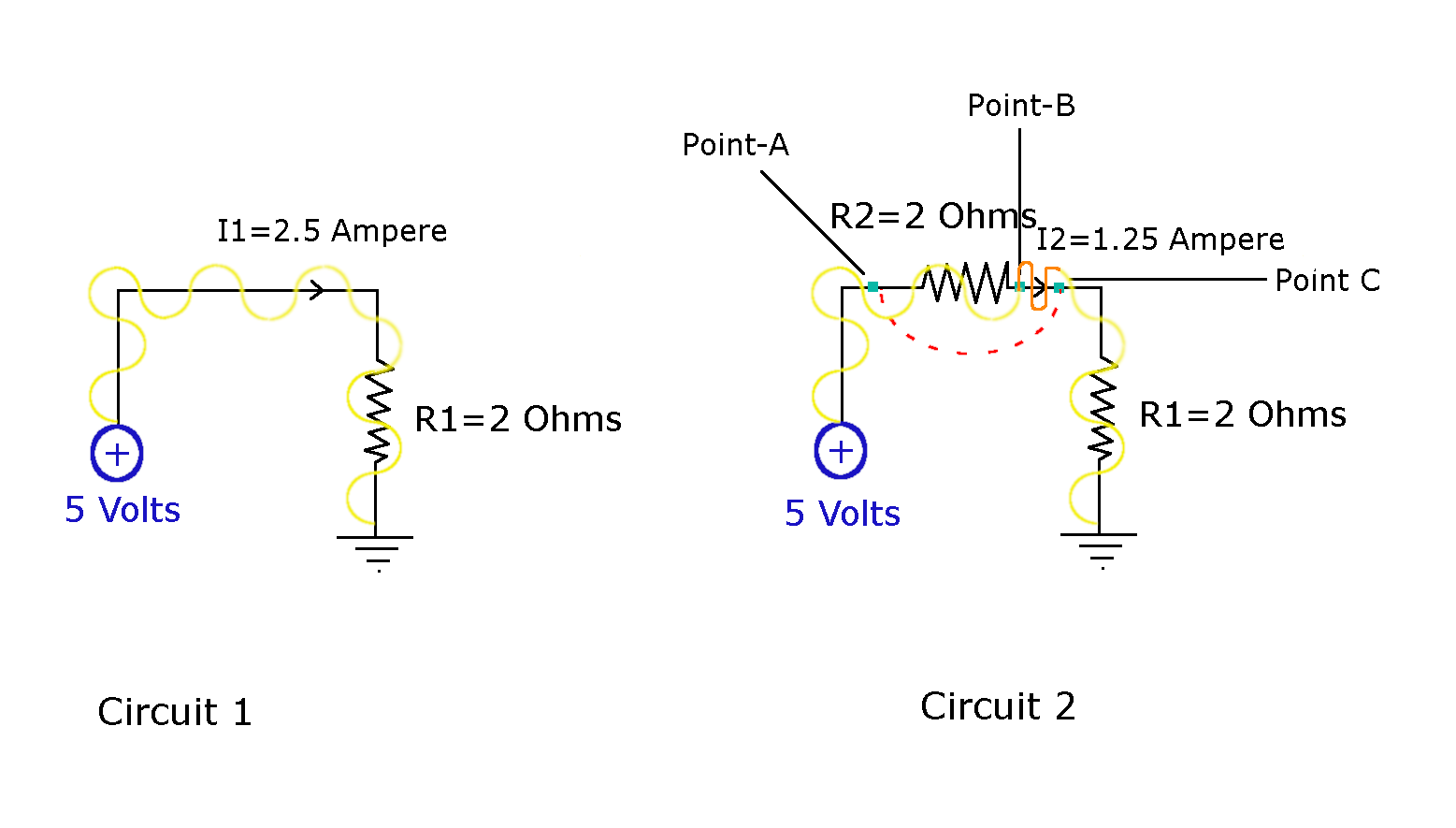
Mathematical explanation of electric short
From formula V=IR, we derive I = V/R. So in Circuit 2, if we make the resistance R2=0 between points A and B, suddenly by connecting another wire shown as a red dotted-line, then Current I2 becomes V/0=Infinite, which is called a short circuit as it increases the temperature so high that it catches fire and burns to ash.
We will explain the same phenomena from a detailed physics perspective at atomic level. We will think current as an electromagnetic radiation/field travelling within the wire. However for simplicity we show it on the edges of wire with the yellow line in the picture but not visible to the eye.
This current field is a wave and as it travels in space it distorts space-time around it. We have learnt from the above content of this blog. That the space-time calibration is unique at an atomic level. So this yellow wave will also change the space-time ratio of the wire and the circuit as well. Below is the table with space-time ratio calibration done for the wire in the circuit 2.
| Location on Wire | Space-time ratio |
| Point A | 4.98765432 |
| Point B | 4.98765451 |
| Point C | 4.98765452 |
No-Short-Happens: If we short point A and Point C slowly by using another wire, shown with a red-dotted line, and also removing R2, then Circuit 2 becomes like Circuit 1, and there is no electrical short or damage. And the current slowly increases from 1.25 to 2.5 ampere.
Short-Happens: If we short the circuit very quickly keeping the resistance R2, and connecting point A and Point C at the same time by using another wire shown as a red-dotted line.
Initially, the space-time ratio is 4.98765432 at point A and its value is 4.98765452 at point C. After shorting, the space-time ratio at point C becomes 4.98765432(equal to Point A value). However the space-time ratio at point B is 4.98765451. Becuase the space-time ratio is increasing along the length of the circuit wire and we know this from the table above.
So we see that in a very small distance (From Point B to Point C) and a very small time interval spanning nanoseconds, the space-time compresses by 0.00000020 ratio from Point B to Point C. This 0.00000020 ratio is a very large difference at atomic scale. And the sudden change in space-time by a huge amount, heats the wire quickly, and it catches fire and stars burning. You can also see the space-time compression with the orange color wave in the picture above.
The reason for me to explain the electric-short was to explain the magnetic-short which is exactly the opposite and used to create space-time holes in magent.
How space-time flows in Magent ?
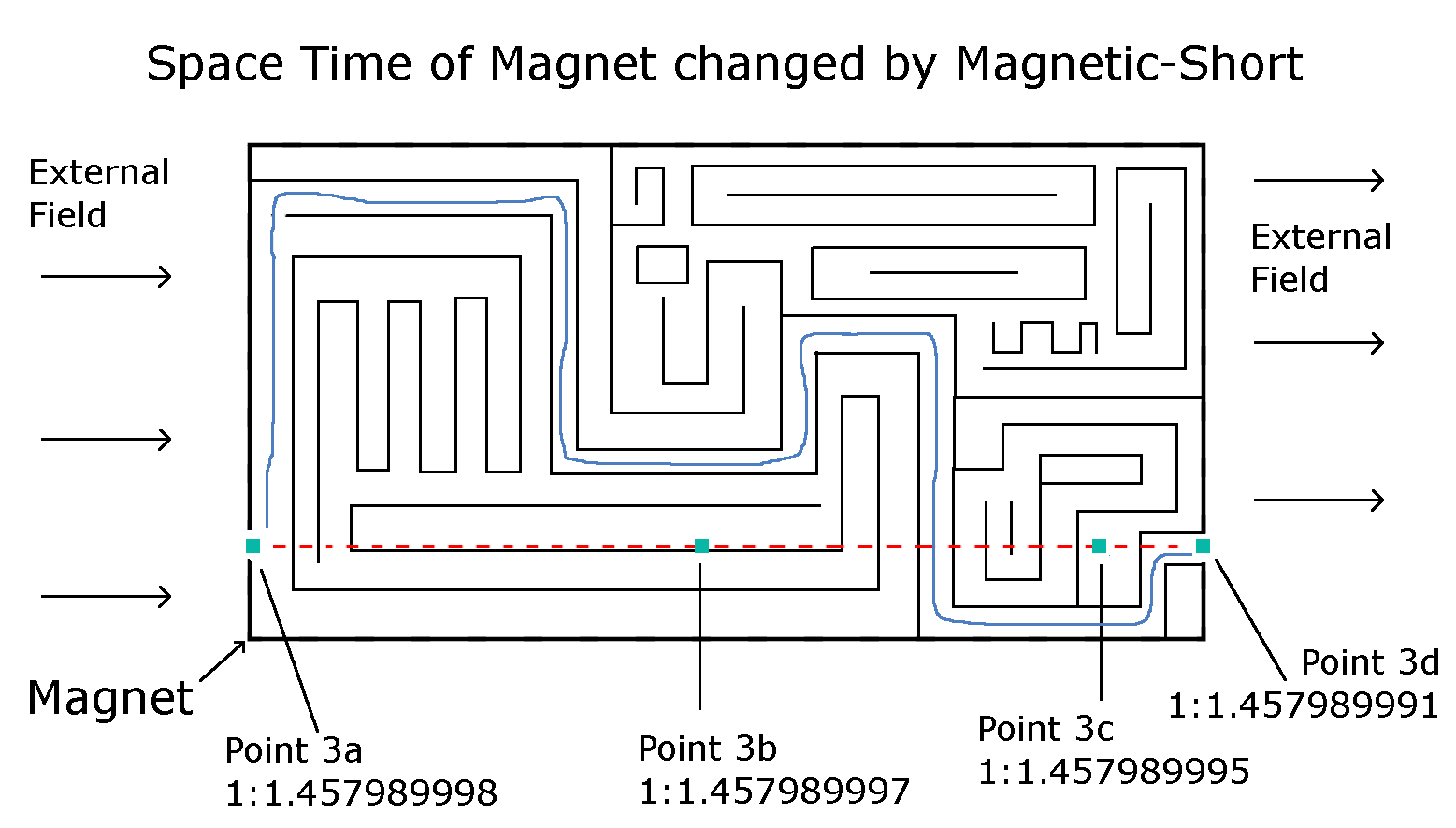
| Absolute Space-Time Reference | Space-Time Ratio Before Magnet is created | Space-Time Ratio After Magnet is created | Location Inside Magnet | |
| 1 | 1.457989998 | 1.457989998 | point 3a | short-circuit |
| 1 | 1.457989997 | 1.457989997 | point 3b | no-short |
| 1 | 1.457989995 | 1.457989995 | point 3c | no-short |
| 1 | 1.457989991 | 1.457989998 | point 3d | short-circuit |
The above table shows the calibration of the magnet both before and after it is created.
As shown in the image, the green color are the points at which we know the space-time ratios. And I have shown only 4 points, but more points are taken into consideration along the red dotted line. You can also see from the second column of the table above that the space-time ratio is gradually decreasing along the red-dotted line.
We pass electric current after some time, which is shown by the black arrows on left and right of the magnet as an Externel field (Electromagnetic radiation) in which the magnet is placed. This current changes the wave functions of electrons of the magent. Such that from point-3c to point 3d, the space-time ratio instead of decreasing, suddenly expands/explodes by a very small amount 0.000000007 in just a few nanoseconds. So this sudden explosion/expansion of the space-time in a very short interval of time, gives the magnet a very powerful magnetic field which lowers down the temperature by a huge amount around it.
Due to which the point 3a and point 3d get the same space-time ratio. Not only that all the points indicated by the blue color line inside the magent achieve the same space-time ratios. And hence when we say that the space-time flows, it means, it is the same from point-3a to point-3d of the magnet, or ratio of time passage of space in the front and back of the magnet becomes the same.
According to the paragraph above there is a statement that “space-time is unique” is not possible naturally. So there is an exception here, as we have made it same at mutiple locations inside magnet.
In rough language we can say that we were able to short the magnetic circuit, by making space-time same at both points. In comparison to an electric short where we bring the 2 wires of the circuit in contact with each other to make space-time change suddenly, which leads to burning of the circuit due to excess heat and high temperature. Similarly in Magnetic-short, the temperature drops suddenly, as the space-time becomes the same on 2 different points of the magnet.
How can we calculate time in nano seconds or picoseconds?
When we look at the wall clock, we can hardly see the clock second hand moving 60 times a second. Then how is it possible to measure time in a very small fraction of seconds in nano seconds? The answer lies in one of the blogs we had written earlier on “Measurement of the speed of light”. The basic priniciple of measurement of time or distance accurately to 10 or 20 places in decimal lies in the concept called as “Conservation of Energy” and “High Precision Formulas”.
Conservation of energy means, that any form of energy, example heat, will be lost if not insulated properly. So the heat energy will have to be saved/conserved/protected from getting wasted outside the lab where measurements are being taken. So all the losses that can happen when we are making our calculation are accounted accurately to give such an accurate measurements using complex formulas.
High Precision Formula means, that we use the same formulas that you may have learnt in school and college. The only difference is the number of decimals used. All the input variables of the formula use 10 to 20 places of decimals for very high accuracy. Lets say we know that if we burn petrol of 1 ml volume, it releases 1000 Joules of energy. In deep-space, instead of 1ml we burn 1.0090830852 ml of petrol and it releases 999.974376287 Joules of energy.
Now we use petrol to burn a “very small electrical circuit” and calculate that it takes 2ml of petrol to burn it completely, so we know that to burn the circuit we need or generate around 2000 Joules of energy. From below formula, we know that.
watt-hours = joules ÷ 3,600
Now we burn again exactly similar “very small electrical circuit” but not by petrol. We use an electric short-circuit as explained above, by passing current. We know from below formula that
watt-hours = amp-hours x volts
So the watt-hours will be same in both cases. And we equate them, to measure the Hours(Time). We can find the hours with a decimal accuracy of upto 10 or 15 places.
Side note: This blog is written only for sharing basic knowledge. Please do not attempt any of this, firstly because it is done only by highly skilled and trained professionals. And secondly because the actual formulas in the real world are much more advanced and kept confidential to prevent its misuse.
 Entrepreneur